
Table of contents
Introduction
Gaming is an immersive experience that transcends the boundaries of everyday life and can convey many thoughts and feelings only caused by the game. One unique feeling, that is a little different for everybody, is “character embodiment” or “embodied gameplay”, where players feel like they are the character they control. This phenomenon goes beyond mere interaction; it’s a deep connection that blurs the lines between the player and the character, allowing players to immerse themselves fully in the game world. They feel as if they are the character that they’re playing. The feeling extends even outside of the game, where the players play a game for days and all they think of during their day is what they’re going to do next in the game.
You may have had this experience too, so here are some simple examples; I’ve had it with Zelda: BOTW, where I played the game almost everyday for weeks, and I kept thinking about the puzzles I was stuck at and how I wanted to just ride around on my horse through the world. My boyfriend had it with Assassin’s Creed 3, where he felt like he was in the Assassin’s Creed world in real life too.
When designing a game, you need a goal, what do you want the game to be and to achieve. During this research, I want to find out how to design a game that conveys this embodied gameplay feeling to the players. What choices do you have to make in the design to achieve this effect on the players, and is it even possible to design a game specifically around this feeling that the players may have?
I believe it is not only possible to design such a game, but also a necessity for pushing the boundaries of what games can achieve. This R&D project will explore the concept of embodied gameplay, and look into the psychological aspects of this phenomenon. The research will result in a set of requirements to guide game design, with which I will design and create a game. It will be (almost) completely narrative based, like a visual novel, to keep it as simple as possible, as I want the list of requirements to be the bare minimum to designing a game with such an effect.
In the end, this R&D project will result in thorough research, both desk and field, at least one prototype (with multiple iterations) of a game, and the conclusion; which will be the list of requirements and things to keep in mind when designing a game to convey embodied gameplay to the players. This project will explain what embodied gameplay is and what it does to a player, how to design a game with the goal to achieve this effect, and have a prototype of a game that applies and proves the research.
The research is based around the question: “What design choices are necessary to create a game that provides players with the feeling of embodied gameplay?”
Research topics
The sub questions that I want to look at are:
- How can a game convey emotions to the player?
- What are the elements needed for the player to feel one with the player character?
- How can narrative aspects play a role in conveying feelings and emotions to the player?
- How can a game feel like reality to the player?
- What are the boundaries wherein the player feels like the choices they’re making are still realistic, within a game?
- What are the minimum requirements for the player to feel the desired effect?
The research and development cycle will look as follows: Firstly desk and field research is done to answer some or most questions – then a prototype is created – tests will be performed using the prototype – and the results are taken into account for the next research phase.
Research
Some of the research topics overlap, so first I will summarise my findings and present the most relevant information gathered during the research. Then at the end, each question will have a short conclusion, to tie everything together. I’ve done both desk and field research, where the desk research was done online and in books, and the field research mentioned in this section is just peer research. Each topic below will include findings of both types of research, even though field research was done after the desk research. To find out more about the field research, go to the field research part below.
Interaction and control
Gameplay is induced by the aspect of choice, and interaction. How can interaction in a game help with achieving the embodied gameplay feeling?
The freedom to make decisions and have a sense of control over what happens in the game or what the player character is doing, is a large part of the experience. A game packed with interaction and choices induces a certain experience for the player, which can be defined as gameplay. A simple example is a game such as chess, where the player constantly makes choices and has to think critically about their decisions. It can be immersive, and is definitely a gameplay experience for the player. But the player does not feel like they are the king or any of the pawns, even though they have control over the “characters” on the board, it’s very interactive, and there are a lot of choices to be made constantly [1].
So interaction is an element needed to create gameplay, and some level of immersion, but does not directly cause a feeling of likeness for the player to the player character. It’s not even necessary to have interaction for a person to feel likeness to a character. A person can feel one with the main character of a movie for example, even though there’s no interaction involved. Looking at it this way, interaction is not necessarily one of the requirements to convey character embodiment. But it is part of what makes a game a game.
That’s not the final conclusion though, because there is a way to put interaction to good use, and to use it to help give the player the sense of character embodiment. I’ve found that the way to do this is to give the player a good feeling like they have control and the feeling of agency. During the field research many people mentioned they liked having much control over their character, and that that was one of the reasons they felt one with the character. For example, somebody mentioned they liked Baldur’s gate 3, even though the player has control over multiple characters, the fact that they have so much control and can decide the whole story for these characters makes them feel so much easier to connect to the characters. So player agency is an important requirement to get the embodied gameplay result, but to what extent this agency is necessary is still required to be tested later on.
Feedback
This extends a bit on interaction and control, when someone interacts, they expect feedback, because that’s part of what makes it interactive. I’d like to find out what kind of feedback the player needs to receive to feel character embodiment.
The feedback a player gets contributes to the experience and decides a lot about how the player feels when playing the game. When a player does something in a game, and there’s no effect, then it feels less real, can diminish the immersive effect, and can break the flow. It’s the feeling of expectation that is not fulfilled. Then there’s also the fact that games are rule-structured, when a player does something in a game, the consequence is already defined. Järvinen et. al. (2002)[5] writes that it has to do with the relation of risks and rewards; “The larger the risk the player takes, the bigger should be the reward.” It makes sense, because when a player takes a large risk and gets a reward that is much smaller in relation, it can feel disappointing. So when a player puts a lot of effort into something, maybe grinding in a game (risk/action), and then they lose everything they worked towards, maybe their resources got stolen (reward/consequence), it can invoke even more than only disappointment, and maybe even sadness or anger. There are a lot of ways to use this to invoke emotion, but it has to be done the right way, otherwise the experience is simply not enjoyable.
It is a possibility to get the player to feel closer to the player character by evoking emotions in this way, but there is a thin line between dissatisfaction and immersion. Though people have described they even felt immersed in games that were very dissatisfying, such as games where they repeatedly try to complete a level in a game, and keep failing. The expectation of the reward is enough to keep immersed and keep playing. That’s what I found in both field research and in [1 and 5]. Someone for example said they loved Hollow knight and felt really immersed, even though they got stuck at a lot of points in the game, and felt like giving up many times.
During the peer research I did find that what creates more embodied gameplay is when the feedback they receive is exactly or close to what they expect when they interact and make a choice. The feedback needed in a game for a player to feel embodied, has to correspond well with their actions. Failing when doing what you think is right and should work, diminishes the feeling, even if it doesn’t make them less immersed. In conclusion, the feedback the players receive can reinforce their sense of agency and connection to the game world, which heightens immersion.
Player character appearance
The goal is for the player to feel as if they are the character that they’re playing, the easiest way may be to put the player inside of the game, both their appearance and personality. Then it would be obvious that the player is the game character, but that is not easily achievable in every game, and the goal of the research is to find out what is minimally required to get character embodiment. This section’s goal is to find out how the player character and the other characters can be represented to feel emotional connection to, but to be as minimal as possible still.
One really interesting study that delves into the subject of emotional connection to minimal shapes really well is the study by F.Heier and M. Simmel [2]. Which proves that humans don’t need much like facial expressions or even recognizable shapes like lifeforms, to feel compassion or link a story to the characters perceived. They show a video not longer than 3 minutes to their test subjects, with very minimal shapes moving around. Tested in multiple ways in different groups, the results clearly showed that the subjects recognize these geometrical shapes as animated beings, some even thought of elaborate stories to connect to the video. When asked, the subjects all connected a certain personality to each of the shapes too. A part of the video can be seen on the right.
The study by Heider and Simmel explored how simple geometric shapes can be perceived as beings with intentions and emotions, despite lacking human-like features. They identified four types of movements in the animation:
- Successive movements with momentary contact: Shapes moving into each other or the environment, creating the impression of kinetic energy transfer. Viewers perceive this as a collision, where the movement of one shape affects the other, akin to physical interaction between individuals.
- Simultaneous movements with prolonged contact: Movement originating from something, such as opening a door or shapes hitting each other. The movement is perceived as originating from the shapes themselves due to their ability to move independently, leading viewers to attribute intentionality to the shapes’ actions.
- Simultaneous movement without contact: Shapes moving independently but perceived as interacting, like one shape following another around without physical contact, which can be seen as chasing. This implies psychological interaction between the shapes, as viewers attribute motives and relationships to their movements.
- Successive movement without contact: Movement caused by changes in the environment before contact occurs, giving the impression of intentionality. Such as one shape moving away from another before it reaches it. Viewers interpret this as anticipation or response to the environment, suggesting that shapes possess awareness and intentionality beyond mere motion.
These movements are interpreted as deliberate actions with motives and personality traits, despite the absence of explicit features. For example, a larger shape hitting a smaller one may be perceived as aggression, while a shape entering a house may be seen as seeking refuge.
This is very interesting research, because this study illustrates how viewers attribute human-like characteristics and intentions to abstract shapes based on their movements and interactions. The shapes are viewed as though they have emotions, despite having no resemblance to any life form.
Add interaction to this video, and you have an example of a game where the players can connect emotions and personality traits to the shapes, and see them as characters. But I’m not sure if a simple shape is enough for the player to feel character embodiment.
From the field research there were various answers to what type of character made the people feel character embodiment. Some felt it more with characters that they could adjust appearance-wise, but some felt the same thing with characters that were pre-designed and had a noticeable personality. Some even felt it with characters they couldn’t see, such as some visual novel games, or characters that didn’t talk or show much personality at all, which is the case for many story games where the player has a lot of agency. What they all have in common is that the player character is represented in some way, it is clear that the choices they make affect the game character. The character doesn’t have to be shown, and doesn’t have to talk much in the game, but the player needs to be aware of their existence.
Player’s presence in the game world
When playing a game, players have shown behaviour as if the world inside of the game is with them. Players might instinctively duck when a virtual bullet approaches or shudder upon crashing their in-game car. By playing a high tense game, the player’s heart rate can go up, they could get short breaths, and a lot more physical or mental effects can be found by playing games. This of course varies per player and situation, one of the clearest signs of immersion within the game world is the flow state, but the effects can be achieved even without getting into that state. In the flow state, instead of the player being immersed into the game world, the game world is brought out to them, they stop being aware of themselves. Achieving the flow state or similar levels of immersion can serve as a gateway for players to truly embody their in-game characters
The flow state may be something different for each player, and some get into the flow faster than others. A research report by Järvinen, et al. (2002)[5 ]describes that there are at least some prerequisites that need to be in the game to get into the flow; The structure and tempo of the game, aesthetic enjoyment, consistency, and social interaction. And an article by A.Helfant (2023)[6] lists eight prerequisites for an action to be considered an action in the flow state. They both cite the same book[7], which describes the flow as a much broader concept, something that can be achieved with only the mind, even outside of a game. It can even be something that lasts for years or for a majority of the life of a person, because the author Cziksentmihalyi describes it as a sense of control over one’s psychic energy and order in the consciousness. The only thing in the way of getting in the flow for a person is their mental state of mind, he writes that schizophrenics for example can’t get into the flow state because of uncontrollable and distracting stimuli, but the same goes for self centered or self conscious people. Anything in the mind that induces stimuli that can’t be perceived in the world outside of the mind, can be an obstacle to achieve flow.
What can also contribute to the immersive experience in gaming is the ability to bridge the gap between the virtual world and the player’s reality. This process involves creating an environment where players not only interact with the game world but also feel as though it extends into their own surroundings. By blurring the boundaries between fiction and reality, game developers can evoke a sense of presence and agency that transcends the confines of the screen. Additionally, elements such as realistic graphics, dynamic sound effects, and responsive gameplay mechanics contribute to the illusion of being fully immersed in the game world. By bringing the game world into the player’s world, developers can create experiences that are not only entertaining but also deeply impactful and memorable.
Participants from the peer research have also mentioned that both the flow state and the feeling of the game world being transfered into their own, has contributed a lot to feel the embodied gameplay effect. Though no one could describe what caused them to feel like the game world was incorporated into theirs. For example someone mentioned Animal crossing New Horizons as a game where they felt character embodiment. For any other part of this research I would not use this example, because in that game you have full control over your character and their actions, can adjust their appearance to look like your own, use your own name, and most importantly the world you play in plays in your time zone and hemisphere. The player can change the game world to their own liking, and a lot of aspects overlap with the world in real life. Feeling character embodiment in such a game feels logical, so I don’t think it’s a good example. But the person that mentioned this game, described that the things they saw in real life felt like they came out of their favourite game, and still didn’t understand what it was about the game that made them feel so much as if they are living on an animal crossing island.
In conclusion, the phenomenon of the player feeling as if their world has changed to be similar to that of the game that they love to play, is one that is not easy to understand. The origins of this feeling are not entirely clear, but it is clear that it helps with creating the feeling of embodied gameplay. It may need some more research to understand this concept better, and I’ll come back to this if I have the time.
Personal limitations
There are a lot of people in this world, and it is not easy to design something that affects every single person in the same way. For this research to work effectively, some groups of people may not be ideal to test with, and there are a couple of sources that decrease the target audience slightly. One pilot study that aimed to research the same subject as this research does, concluded that players with no computer experience, or players that just weren’t gamers, were too confused by the gameplay that actual content wasn’t even comprehensible [4]. Not knowing how controls work, not understanding the basics of a game, not recognizing anything that happens, sits in the way of experiencing the actual game. It is not proved that it is impossible for these players to get immersed into a game, or feel embodied gameplay, but it is not effective for this research, and will therefore be excluded.
The controls used for the game are also important, it has to be something familiar to the player too. Sometimes the use of keyboard/mouse or controller is decided by the type of game. For example racing games more often use controllers and shooters use keyboard/mouse. But since there are different controller button layouts, not everyone is used to a controller, everyone that has used a computer has used keyboard and mouse, and keyboard/mouse is most commonly used, the game for this research will be built around keyboard/mouse controls. Also it can be argued that something like XR could be more effective to reach the desired effect, but for a prototype like this it is too complex and it has been proven that it can be achieved with keyboard/mouse controls, so that is also not an option.
Concentration
Keeping a player’s concentration is a fundamental element in maintaining immersion within a game [5]. The ability to maintain focus throughout the gaming experience is integral to enhancing the overall quality of engagement. Indeed, the depth of immersion directly correlates with the level of concentration that the player has. When a player remains fully engaged, they are more likely to develop a profound sense of embodiment within the game world. However, this immersive state can be fragile and easily disrupted. Any lapse in concentration, even momentary, can disrupt the player’s connection with the game world, making it challenging for them to re-establish immersion once it’s broken.
By emphasizing the importance of sustained concentration, game developers can create experiences that captivate players from start to finish. Designing gameplay mechanics, narrative elements, and visual stimuli that continually engage and challenge the player can help maintain their focus and prolong immersion. Additionally, incorporating dynamic and responsive features within the game environment can prevent distractions and interruptions that may disrupt concentration. In conclusion, the ability to sustain concentration throughout the gaming experience is important in creating a deep and lasting sense of embodiment for the player.
Field research
Peer research
I asked my peers if anyone wanted to share one or more games that were really immersive for them, games where they really felt like they embodied the main character; and what was that experience like for them? What made that game feel like that for them?
To create a bit of a background for everyone I also asked a couple of basic questions beforehand. This is just to be able to understand and compare the experience they describe in a better way, and so I could decide if I could take their response into account for the research. Some people thought some of these were personal questions and didn’t mind sharing with me, but would not like to be mentioned in public. It’s just for me to create a background and decide what answers I can use in my research and what stands out from the others. So I quickly decided that these answers are just for me and, same as the names of the people I questioned, will not be mentioned in the article.
- Do you usually play a lot of games? How often and how long at a time? (to see what kind of gamer they are)
- What kind of games do you usually play? (to see what kind of gamer they are)
- What kind of tasks make you feel easily immersed and for how long do you manage to stay immersed in a task? (to see if immersion is relatively easy to achieve for this person compared to others)
- Would you describe yourself as someone who can easily emotionally connect to others and why? (to see if they’re the emotional type, compared to others)
Then I asked the big question: “What were games where you felt character embodiment?” and I got about 10 very useful responses, some people even described multiple of those experiences.
Some of these experiences are:
- Detroit Become Human. He explains that he didn’t feel that immersed into the game world itself, but he did with the characters. In that game the player is in control and has to make a lot of choices that influence the story and flow of the game. He describes that he felt more emotional while playing this game than he usually does with games, that he started thinking differently, and sympathised with the characters in ways that he usually wouldn’t. In this game you constantly have to make important decisions that have great influence on the characters, which made him consider the consequences of the actions he made in the game. I see the way he sympathises with the characters, thinks differently than usual, and is very careful and considerate, as a form of character embodiment.
- Assassin’s Creed 3. He describes a time when he was younger and played the game almost every day, and felt so immersed into the game world that he started thinking and acting like the main character. He loved the things he could do in the game, which were not possible in real life, and it became an escape from reality for him. His character embodiment comes from the game world that was so impressive for him, the things he could do in the game, and the character he played that he thought was so cool.
- Hollow Knight. A game that was mentioned multiple times, most of these people usually play platformers. This specific girl also mentioned Hollow Knight, but doesn’t usually play such games, mostly shooters. The gameplay was not one of the main things she liked about this game, she mentions that she barely even noticed it. What she loved was the story, the simple yet mysterious and interesting player character, and the impressive visuals. The impressive battles really caught her attention and she loved all of the well thought-through characters in the game. What was noticeable about the way she talked about the game was how she constantly said “I”, like “I was trying and trying again to beat this boss, and I didn’t mind failing because I just thought the boss was so cool”, and “Sometimes I had to backtrack and go back to places in the world where I’d been before”. That’s a noticeable proof of character embodiment that I noticed more often in many people.
- Runescape. This one was also mentioned a couple of times. One of the people mentioned he loved the freedom of choice in the game, the fact that there were multiple storylines, but that he was not bound by the story because he could do whatever he wanted if he wanted to. He was immersed in such a way that he liked to be strategic in the game and do a lot of research to play it exactly how he wanted to, and the fact that he could meet up and play with his friends in the game added to the immersive experience very well too. He says he and his friends liked this game so much that the immersion extended beyond the game into real life, and they would talk about the game constantly in real life.
- Spiritfarer. She explains that the story and the world the game plays in is really intriguing. The character she plays as doesn’t say anything, all they do is act and the NPCs in the game respond to the actions. She likes to take care of her spirits on her boat, and wants to keep them happy. She’s like that in real life too with her friends, so because the game has a lot of freedom and time to just make the NPCs happy made her love the game a lot. What she also really liked was the feedback she got from the characters and how taking care of them made them feel nice. In the game you have to say goodbye to a lot of NPCs and she was so immersed that she said she cried almost every time.
Other mentioned games were: Baldur’s Gate3, Sims 2, the 3 Horizon games, Cyberpunk, Dark Souls, Stardew Valley, Animal Crossing, and many more.
The findings of this peer research is included into the research part above.
Testing the game
After researching came development, and quickly after developing a simple prototype was ready for testing. To see more of my development process, go to the development part below. After each test comes a bit more thinking and making, where I look at the results of the test and adjust the prototype based on that. I will explain what the prototype was for each test, what I tested on, and how I tested it.
Test 1
The first iteration was very simple, all I wanted to test at this point was if the story made sense, if the controls that were there so far made sense, and maybe if this was even enough to convey some embodied gameplay feel already. I decided that work was a good place to do this, as there is a great variation of people that come by at the cafe that I work at, and it’s a great way to still do schoolwork while working my job. I know a lot of regulars so my plan was to ask them 10 minutes of their day to play a bit of the game and answer some questions. Below is a screenshot from what the game looks like at this point, very simple, but the story is there.
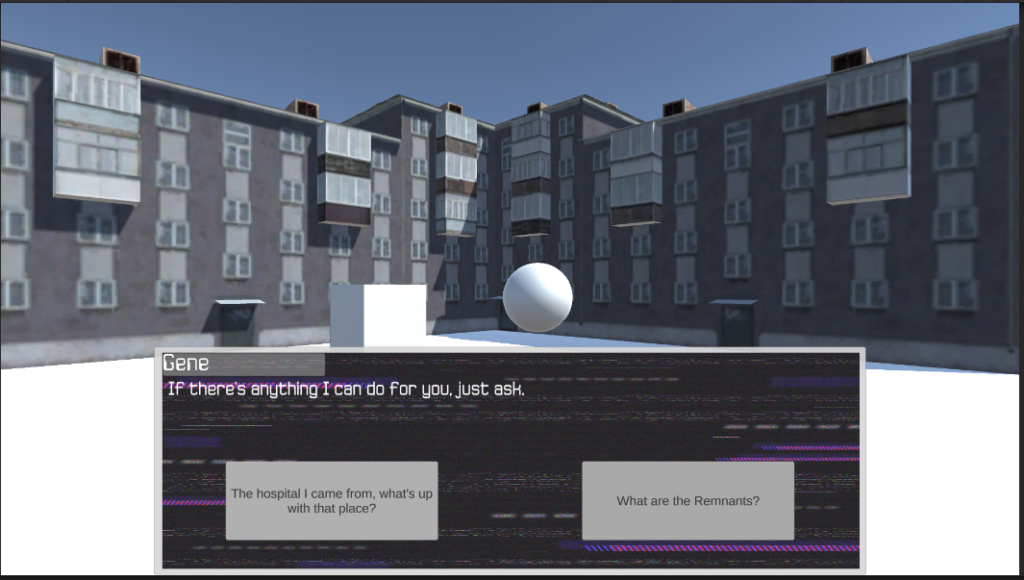
This is the way I planned to test:
- First I explain what I’m researching and what I’m trying to make
- Then I ask them the 4 questions that I also asked during the peer research
- Then I explain what I have so far and let them play the prototype
- Lastly I ask them some questions about their experience
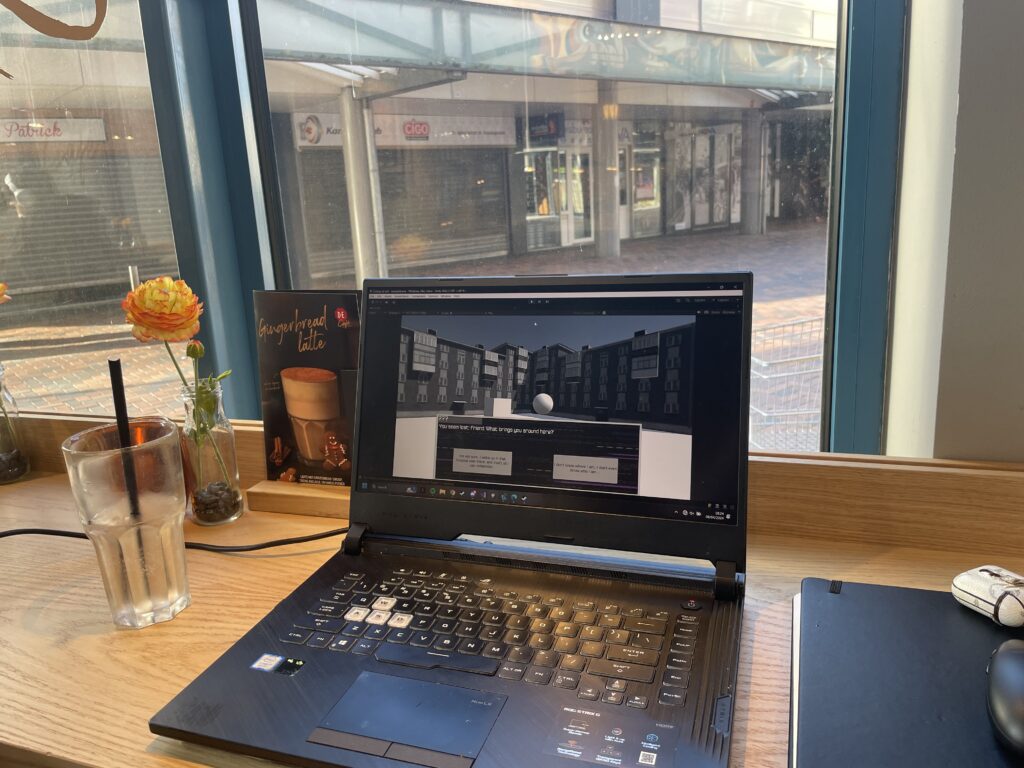
The test setup in your favourite Café in the Bijlmer!
Some people didn’t have as much time as others so for some people I skipped background questions and went straight to playing the prototype and asking what they thought of it. I didn’t do any of the tests the same way, because it’s chaotic at work, but at least I got the feedback I needed.
I didn’t get to test with a lot of people this day, because I only worked for five hours and most of them were busy hours, but these are the answers that I managed to write down:
Subject 1: One of my favourite regulars! He used to be a gamer but doesn’t have that much time because of work lately, but he is a programmer so he understands what I’m doing. He likes strategic games but also games with great storytelling, such as Red Dead Redemption. To the question if he gets immersed easily he answered that he can get immersed in any task really quickly, as long as he’s got his music to listen to; and he stays immersed until he gets stuck at something (such as a bug in his code!). This is what I observed while he played:
– He often looked back at me to see what he should answer. So he was easily distracted.
– He said: “Ik zou in het echt geen van deze 2 kiezen eerlijk gezegd, maar ik ga dan maar voor deze.”, which translates to “I wouldn’t choose either of these 2 to be honest, but I’ll just go for this one.”, which is not the reaction that I want the game to produce!
– The controls were easy to understand, he didn’t ask any questions about that.
– The prototype is very simple at this point, all I want to test is the dialogue, so the “characters” in the game are just cubes and circles right now. He gave me the side eye because I had to point to the character that he had to click on for the next dialogue section 🙁
Afterwards I asked him what he thought of it, he wrote it down himself for me: “I like the idea, the dialogue system works well, you got the basics of the game down. The story is a bit simple. As I suggested, a text based game doesn’t have to be just talking, consider a little narrator to explain the context and paint the scene. If I may suggest adding at least some figures instead of these cubes as npcs, and it helps to have a second opinion when writing a story. I’m always here if you need me to look at your notes. Overall good start of your game, but I didn’t feel embodied, sorry!”
He stayed to suggest some more improvements and helped fix a little bug too.
Subject 2: Not a gamer, or computer user at all, but likes stories and is happy to just help. This is what I observed while he played:
– Controls were easy to understand.
– He laughed a couple of times (he genuinely thought some parts were funny and enjoyable!)
– He really didn’t understand how clicking on the shapes opened up dialogue.
Afterwards I asked him what he thought of it, this is what he mentioned:
Funny story, he doesn’t like clicking the shapes, the text/textbox was pretty, it was a little short and simple.
Subject 3: No info. This is what I observed while they played:
– Understood controls
– Smiled sometimes
– Said “I hate this guy!” about the angry guard, but didn’t seem to get distracted because he kept on playing and only took his eyes off the screen to look at me for a second. Which is good because this means a little step closer to emotional connection and immersion.
Afterwards I asked him what he thought of it, this is what he mentioned:
Liked the story, it was a nice little game, the background is a bit boring but understands that it’s just a prototype. Liked the characters, thinks it’s cool I made it, and is happy with his free coffee 🙂 He’s excited to see the next version!
Subject 4: She’s a casual gamer and plays games such as Stardew and ACNH. She can be very emotional and gets immersed easily into a game when she has the evening off and can just chill on the couch playing games. This is what I observed while she played:
– “Ooh ik hou nu al van de vibe van de tekst zo!” or “Ooh I already love the vibe of the text!”
– “Deze is gemeen, ik wil gemeen terug doen!” “This one’s mean, I want to be mean back!”
– The controls were clear overall
– After each set of dialogue with a character ended she was like “what now?”, didn’t take initiative to click on any other things and didn’t know to click on the cubes and circles (my bad)
– “Nou deze was makkelijk om te overtuigen!” or “Well this one was easy to convince!” After getting the easy way out with the angry guard, because she made the choices that got her to be let through by the guard the fastest.
– She kept talking about her decisions in the game in the first person, which implies that she could be a little immersed.
– She was also very excited to play, so sweet of her, really tried her best and showed interest. She looked very concentrated and barely took her eyes off the screen, she also thought well about almost every decision she had to make before making it.
Afterwards I asked her what she thought of it, this is what she mentioned:
It already looks cute, even if it’s not finished yet, she liked the characters and she loved the story and she says she would play it when it’s finished.
I asked if she had any other feedback and she said she doesn’t know anything about game-making or whatever, but she would’ve liked to see more visuals for characters.
Subject 5: It was busy so I didn’t watch them play that well, but this is what they said afterwards:
Nice story, could be a bit more detailed and profound, but was overall nice. Did not feel immersed, but thinks some more detail and visuals in the background and characters would help to achieve this effect.
Subject 6: Still busy so I didn’t watch them play, but this is what they said afterwards:
It’s hard to understand that you have to click on the circle to talk, maybe a little tutorial at the start? It was very simple.
Subject 7: Plays shooters in his free time sometimes and always plays because he gets immersed so much into games, it’s like a little different world you’re in. Also a very emotional kind of person. This is what I observed while he played:
– He talked me through every decision he made, so he explained that he recognized the dialogue system from other games, and that it was similar to how other games do it.
– “I like this guy, he’s sassy!” about Gene
– He said that he would like to have the option to pass the angry guard in a different way than through talking to him, such as sneaking past him.
– There was a lot of thought behind every choice he had to make, so at least the options got him to think.
– He was surprised that the conversation with Reeve was over so soon, but I hadn’t added any more of the story yet. He thinks Reeve is too easy to convince, the guard made sense, but Reeve doesn’t.
Afterwards, I asked him what he thought of it, this is what he mentioned:
Really likes it, really likes Gene, would love some more options, thinks Reeve is a little boring, likes the gameplay, is excited for the next version!
Test 1 – Conclusion
This test was very useful and there’s a lot that needs to be changed for the game to invoke embodied gameplay for the player, but there were also some aspects done well.
Tips
For the next test, the story needs to be revised to be more profound, the idea of having a narrator is up for consideration. Some situations could have some more options for the player, or different actions than just talking. There are some situations where the player has multiple ways to get to Rome, but all of them are choosing the right words, in some situations it would be nice to have other options than only words. Some better visuals of the characters and the background would be nice. And lastly it would be helpful if the player has some guide or goal of what to do in the game.
Tops
Most of the NPCs were nice, they showed personality, and helped with the game feel. The dialogue box is simple but nice, nobody said anything about changing that. For some testers this was enough to get a little immersed, even if it was short, they described playing the game as if they were taking actions of their own, and had a posture and attitude as if they were immersed. The next step is feeling so immersed that they notice and mention it!

Test 2
Next day I had to go to work again, so it was the perfect time to test what I improved in the game so far. I didn’t get to do as much as I wanted to during the time I had to work on the game, but here’s what I did manage to do:
- I quickly selected a few asset packs from the asset store and made the game look a little better.
- I added 2 new areas to the game, the hospital and the plaza. And I placed the NPCs in the areas where they belong.
- I took another look at the story, and asked my boyfriend what he would do to improve the story. Together we revised the broad lines of the story to be easier to write out into the game, and changed the dialogue of Reeve a bit.
- I added a sprite for the NPCs, which is just a picture of the sketches I made of them.
Here’s what it looks like now:

I planned to test in the same way again:
- First I explain what I’m researching and what I’m trying to make
- Then I ask them the 4 questions that I also asked during the peer research
- Then I explain what I have so far and let them play the prototype
- Lastly I ask them some questions about their experience
I tested with less people than before, but I did test with subject 1 and 3 again, which I think is the most valuable to process results. The other ones I have not written down concretely, but will take into account for the conclusion of this test.
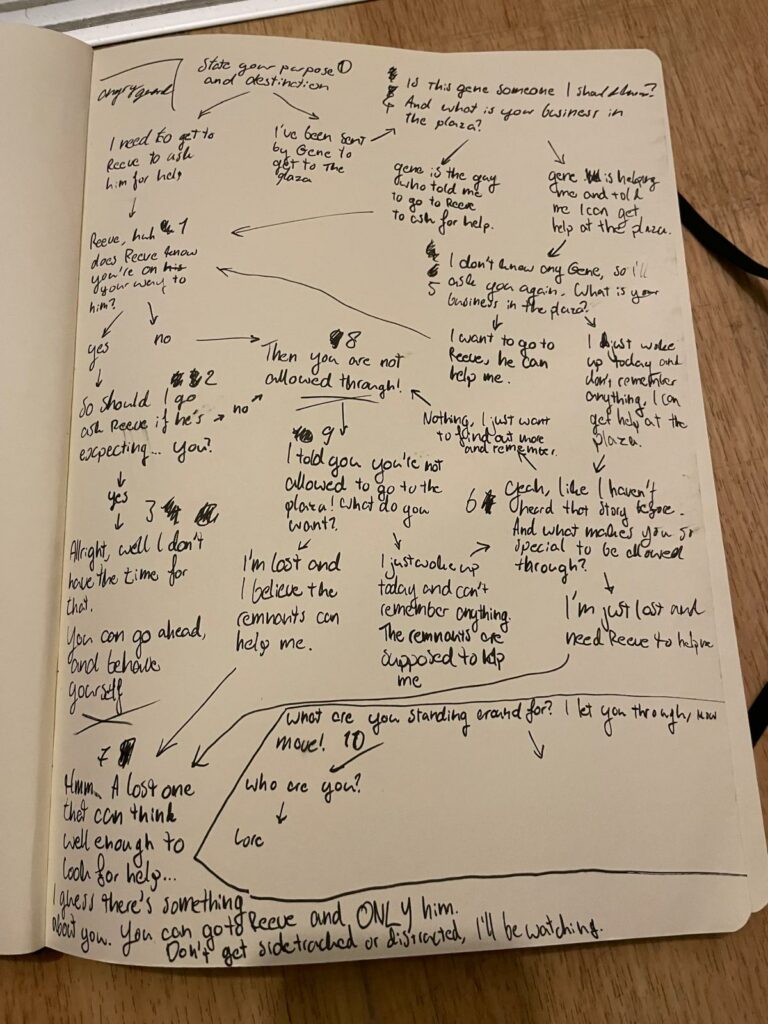
Subject 1 writes: “The game looks better, but is overall not much different from yesterday. The change in font size when I’m prompted with a decision is a little distracting. The story you have written down is solid but the dialogue is messy. I know you know it makes sense, but on paper it is much different than in the game. Overall I do think it has improved a lot and the sketches are a weird but unique touch!”
He refers to the pages in my sketchbook that look like the one on the right, that one specifically is the first set of dialogue with Reeve that I revised together with my boyfriend. Which I admit is messy.
Subject 3 Played the game again and mentioned it was way better than before, just because of how it looks. To him it’s important that a game is visually appealing and doens’t have jarring controls. He just says he likes the story.
Test 2 – conclusion
There needs to be a little more polish for the player to be able to immerse and feel a little more while playing the game. The dialogues of Gene and the second dialogue with Reeve when they’re walking to the old library need to be revised, they’re not well thought through and a little rushed. It’s not clear who the player needs to click on to start dialogue and it’s not very clear what the NPCs are through the sketches on them. This could use a little more polish, and I should consider making sprites if I have the time. I still hadn’t changed the font size changing when going from the regular dialogue box to the box that offers an option. And there are some small bugs that need to be fixed.
Other than that it’s coming together well, it’s better than the first iteration, so it’s making progress!
Test 3
Sadly I was in a rush, this was the last day that I had time to do tests. At this point I just wanted to finish development and see if the game is at a point where the players get immersed enough to feel some kind of character embodiment, or otherwise have enough information to completely finish the conclusion and advise at the end. After the second test I scrapped the second dialogue with Reeve entirely, but I did revise Gene’s dialogue, so only the best dialogue is in the game. I fixed a bunch of bugs, but didn’t did anything polish-wise at all.
I tested with two people who have both tested before.
The first subject liked the game, thought it was a little short, but it was a lot better than what it was at the first test. She thought the switch from the crazy man to the plaza was a bit too fast and out of nowhere (she took one of the shortest routes to the end), and that Gene’s dialogue felt a little rushed. Overal she liked the story and was immersed in a sense that she wanted to know more about the story and liked the characters, though she did not feel necessarily one with the character Echo.
The second subject was basically there during my entire developing process, so besides the fact that he doesn’t understand anything that I’m doing, he’s impressed by how the game turned out in such a short time and liked it overall. He also contributed to the story, so he kind of knows what choices result in what endings. He liked the sketches, to him they made it feel homemade and authentic. He liked that there are multiple possible storylines and alot of options for the player to make. If all the game had was the dialogue boxes it would have been perfect and a great and fun to play game, but the entire look and feel of it could have been done better. Though to him that doesn’t take away the fact that it’s immersive, fun, and has an interesting story and characters. He offered to help create sprites that will fit well into the game, but I’ll remind him if I ever decide to develop this game further.
Overall the bits of polish that I did implement really help for the game to come together as a whole, but for further development this should be done way better. It’s immersive for most people, but to actually evoke embodied gamplay it’s missing a lot of polish, some more bug fixes, and a lot more gameplay.
Development
Designing
Based on the conclusions we made so far, I came up with a narrative driven game with the minimum requirements applied. It’s called: Echoes of self. A lot of the information in the game design document is unnecessary, so here is what’s important to know about the game, and the design choices that have been made.
Story in broad lines:
This narrative focussed game is set in a futuristic but mostly abandoned city. The inhabitants are mostly lost robots that have forgotten their goal in ”life”, but there are still a few humans to be found.
The player plays as Echo, someone who’s unfamiliar to the world they’re in and doesn’t remember much about their past or themselves at all. At the start of the game the player is woken up in an unfamiliar hospital, it’s pretty much abandoned and there’s nobody around to help. When Echo goes outside they find a couple of robots that they can talk to, but most of them seem to have lost their mind and are not of much help to them. Luckily there are a few inhabitants that do want to help and take Echo seriously, which sends Echo on a path to find out more about who they are, during which they find out more about what happened to the world and who the last ones alive are.
Gameplay:
It’s a narrative driven game where the player plays from the first person perspective of Echo. Echo can walk around and talk to the NPC’s by clicking on them and has the option to react in various ways. The choices the player makes influences the story, by making friends or enemies with the NPC’s, which results in different outcomes.
Design choices:
To prove that the player character doesn’t need much to it, I decided on a character that the player can’t see, because it’s in first person, and the character doesn’t even know who they are in the game. It’s a very blank slate but it’s a noticeable character, and they have some kind of personality that’s shown through the narrative. It can also be added onto by the player, because there is a lot of freedom of choice and the story adapts a bit based on the player’s choices.
I also wanted to add in a strange world and story, to see if it is possible to transfer onto the player character.
The HUD/UI may not be as minimal as possible, because of the way the narrative is displayed in the game. But what I want to test this way is to see if it helps if the HUD and UI information is completely integrated into the gameplay. One example that does this very well is Fallout, one of the interviewed mentioned that the game was immersive to them because they almost never had to break concentration in that game world, because all of the necessary information could be found in the “Pip boy”, which was part of the gameplay.
Lastly the way I want to implement the freedom for the player to make their own choices is kind of integrated into
I made some quick sketches to paint a picture of the world. The first picture is what the robots could look like, and the second is how dialog with a robot may look like, including different emotions. In the beginning of the gam, Echo wakes up in an abandoned hospital, so the third sketch is a rough representation of what that room looks like. And finally the fourth is a quick sketch of how the robots might be displayed in the world, I haven’t sketched that much of the world yet though.
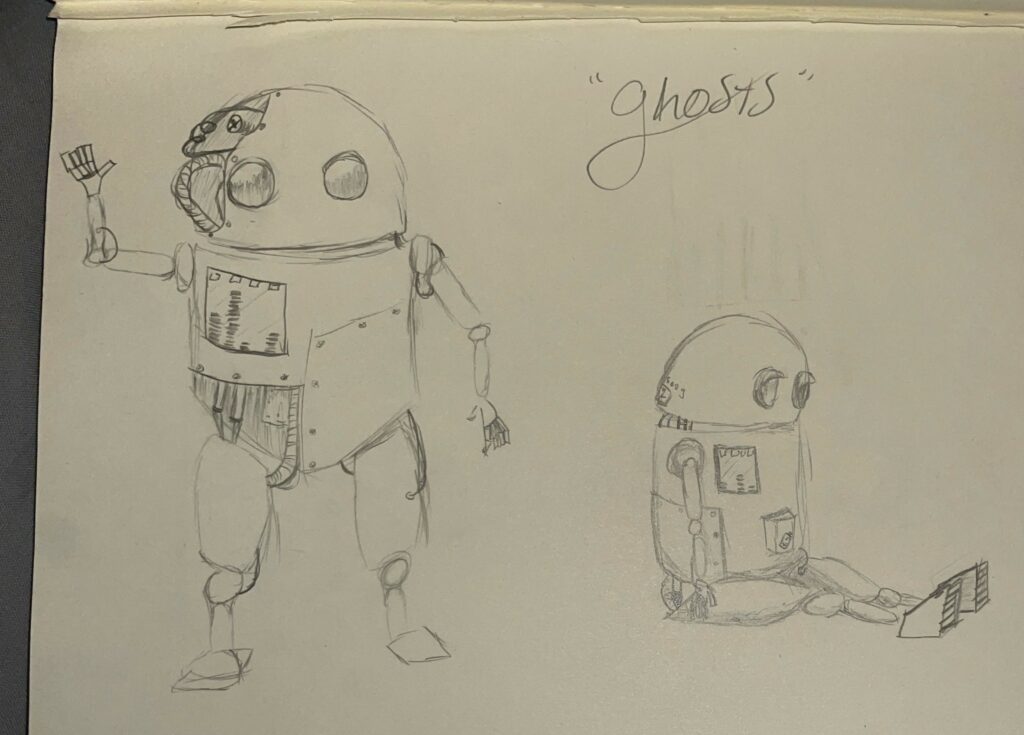


Developing the dialogue system
The most important aspect of a narrative driven game is a system to have dialogue. To create this, I followed two tutorials [9, 10], which helped me create the dialogue system in a way that is easy to use and exactly what is necessary for this game. These are the main components that are required to have this system work:
- First is the text displayer, which pops up the right UI for the situation, takes the information in a “dialogue object”, and displays that into the UI. The displayer only shows the text, buttons, etc.
- For moving through the dialogue, the tree system is what makes that happen. Each NPC has their own tree, some of which can overlap, and it handles what the NPC says based on the player’s reaction. So this allows for the dialogue to flow in a logical way.
- Last important part is the scriptable object which is called the “dialogue object”. This is where all the actual dialogue text and answers from the player are defined.

For each set of dialogue there is a dialogue object, where the index of that object in the tree corresponds with the story on paper. These are the main components (the amount of adjustable components can be easily adjustable, but this is the minimum):
- Firstly the name that is displayed for the NPC during that dialogue.
- The text that the NPC says to the player.
- If the player cannot respond or take action immediately, the tree moves on to the next element/branch in the tree, which has to be defined if the “answers” list is empty.
- If the player can respond or take action, the description of their words or actions is defined in the answers list, where each answer also has to have a number for the next element/branch in the tree.
Simple and minimal is the goal, and that is what is achieved here. Below is an example of how this will look with this specific UI. And below that are some code snippets.
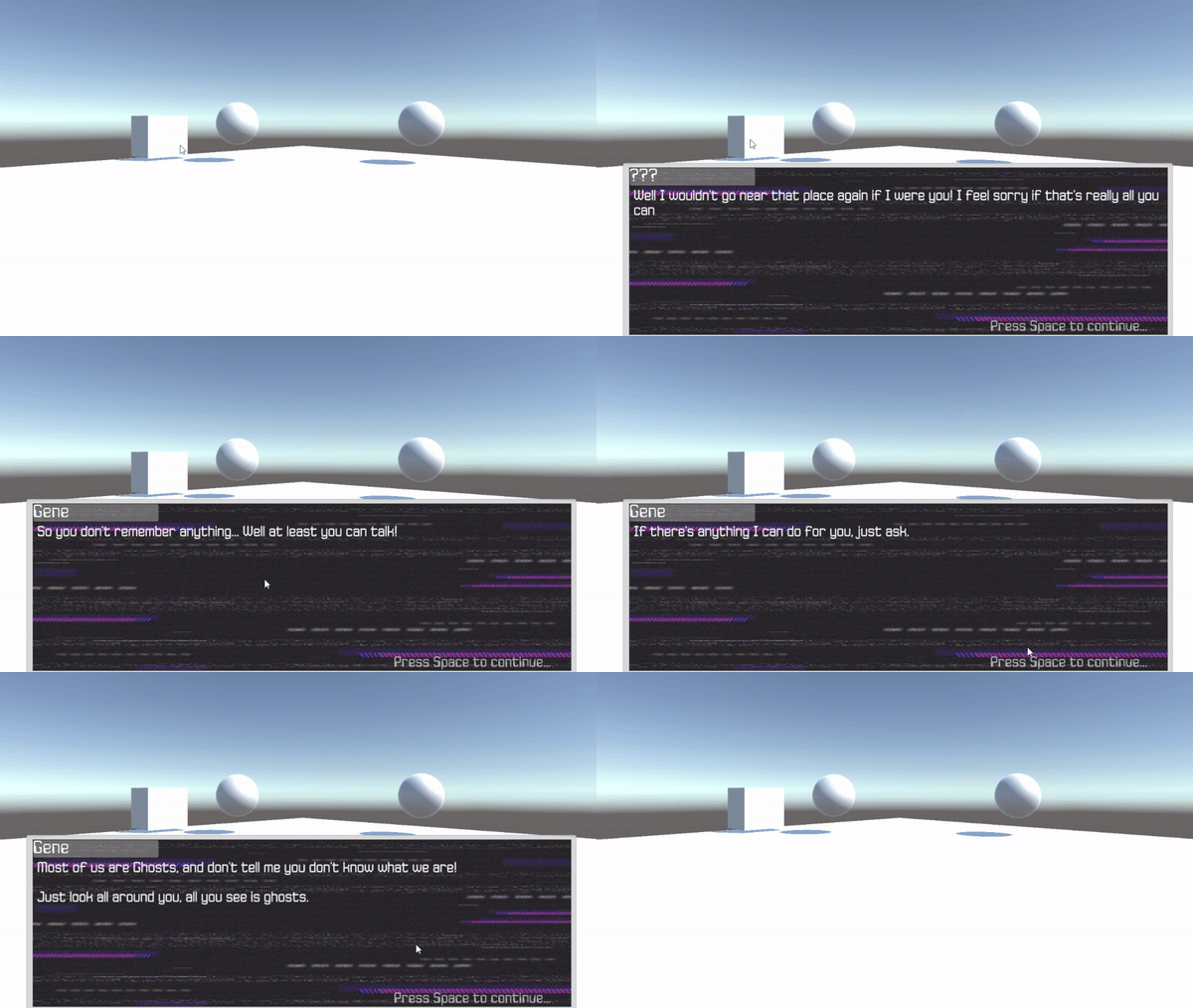

A snippet of the text displayer.
This is how the text is displayed in the interface, how it’s skipped to the next line after pressing space, and it decides if there will be a question asked to the player after the text.

A snippet of the dialogue tree script
This script really isn’t that long or complicated. This is where a player gets asked a question, and where the answer of the player decides the new tree branch.
Creating the gameplay

With the dialogue system I have a basis to create the actual gameplay, which is not that complex from this point on. To interact with the NPC’s and to start the dialogue I created a script for the ghosts that when you click on it, it calls a function from the tree script that starts the dialogue. Besides that each NPC also has the Tree script which can be filled in with dialogue objects that belong to that NPC. Right now the NPC’s all work in the same way, it’s not that complex. I wanted to add more interactions or unique ways in which they could interact, but I couldn’t get to that so it’s just as simple and barebones as it could be. Basically each NPC in the inspector looks like the one on the right.
Each element is a dialogue object, which is an entire set of dialogue. I had written all the dialogue out for each NPC in my notebook to have a clear overview of the tree, and all I had to do was copy that and paste the text into the dialogue object. The tree handles the transitions between sets of dialogue and all that kind of stuff. I did not want to focus on creating or using assets for the NPC’s because the game had to test if it works with minimal polish. So for now the NPCs are just cubes.
Lastly the environments needed to be added to the game, almost every NPC is in a different environment, and the story requires about 5 or 6 different environments. Because of loss of time I managed to get 3 environments in and 4 out of 5 NPCs. And to minimize the interaction required from the player, the player switches automatically between environments.
Alltogether it looks simple and a bit funny, but there’s 4 scenes of the story in and about 5-10 minutes of gameplay (depends on the choices and storyline)

Making the game prettier
“Prettier” is a bit of an overstatement, because I did not have much room for polish. I decided not to add a narrator in the game, so to set the scene and describe the characters I added some simple assets to the environments to make it clear where the player is, and some pictures for the player to understand that which cubes are NPCs.
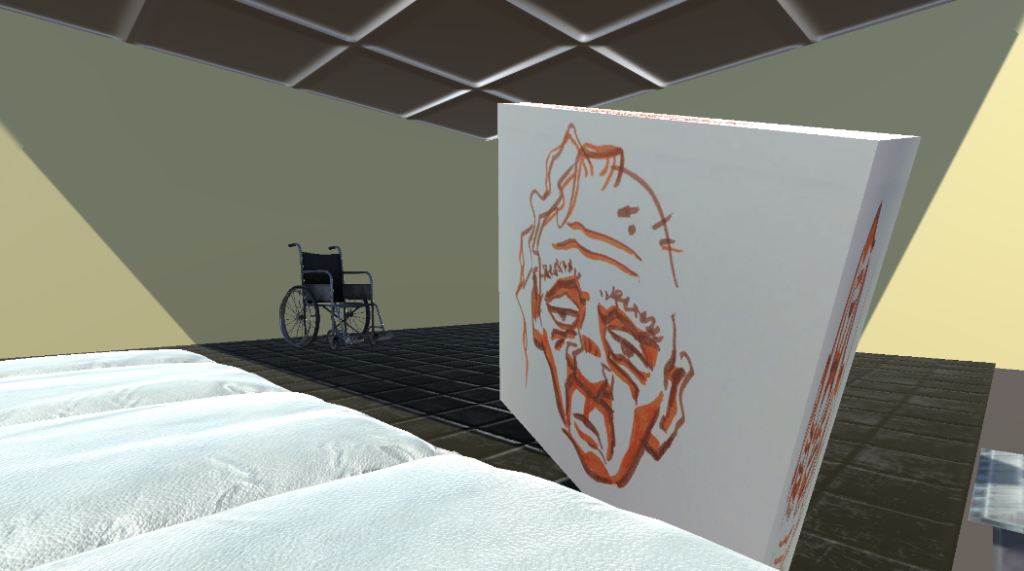
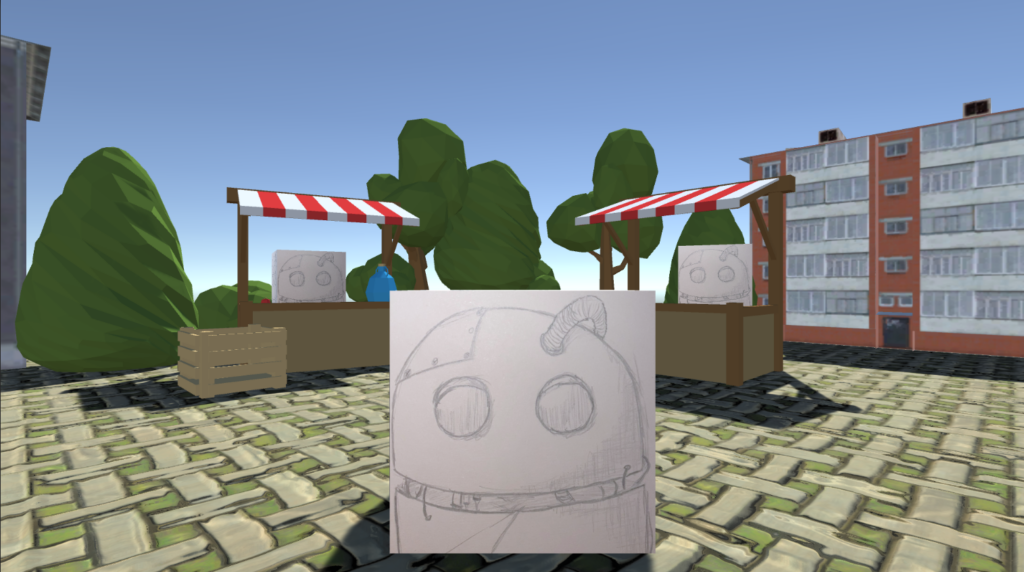
The hospital environment and the crazy guy. It should look like Echo is lying on a hospital bed and the picture of the crazy guy is just some drawing from google, I couldn’t even find the artist.

The city area and Gene. Gene is one of the first sketches I made of the ghosts and behind him are two NPCs that I wanted the player to be able to interact with to give an impression of the ghosts, which I didn’t get to. It should kind of look like an abandoned and neglected city area

The plaza and the angry guard, Reeve is standing behind him. I wanted to have the angry guard in a different environment (the alley), but I didn’t have the time to implement that so when the guard lets you through it reveals Reeve, who you can then interact with.
Conclusion & discussion
After the initial desk and field research I came up with a conclusion on how to construct a game that should convey the embodied gameplay effect
This list was rough and not clear enough to work with, this was the list:
- One of the most important ones is that there has to be a main character that the player plays as. It doesn’t matter in which shape or form the character is represented as in the game, it could be completely invisible to the player like in a first person game where the player cannot see the character. As long as the presence of the character is noticeable in some way at least (such as the camera movement, the character’s voice, or the character being mentioned by other characters). It has been proven that people can feel connected and emotional looking at the simplest shapes interacting with each other; so there doesn’t need to be much to prove to the player that the thing they’re playing as can feel emotions and is “alive” [2]. I do think that the character does need to actually be some type of recognisable being, because then it can actually feel like embodiment, instead of just feeling sad because a circle got hurt. Also because of the results of the peer research, all of the responses mentioned games that have a main character. And about half of them even described that they got this feeling of character embodiment because of the way the character is portrayed. So, there needs to be a singular player character, that has to be noticeable in the game, and preferably has at least a bit of personality to actually make it a character.
- A story is another requirement. Not any simple story will do, there has to be a well thought through world that the game plays in. Because the game world can’t be transferred into the player’s world if there is no game world. It doesn’t have to be a linear story or even one that is noticeable throughout the whole game, for example minecraft’s story is not noticeable during the entire game, but could invoke embodied gameplay for at least one of the interviewed people. As long as it is clear that the game plays in a different world, and it makes sense in the game.
- Minimal HUD is also one of the aspects that will help with the immersive experience. This is one of the ways to minimise distractions and keep concentration [5]. Try to leave out distracting animations and too much information in the HUD, so the player doesn’t have to look away from the game world all the time while playing.
- The freedom for the players to influence the story or character, to invoke emotional resonance [8]. This is not the easiest one to achieve, but the goal is for the player to have a lot of freedom of choice, as it helps incredibly to make the player character more relatable and easier to connect to.
This was not concrete enough, because the “requirements” were just conclusions I made from the research and they’re not clear instructions one could follow. It wasn’t because the research wasn’t good enough, but because the list wasn’t made with the right goal in mind.
The list should be usable to design a game, and because I made the first design based on these conclusions, the design wasn’t what it was supposed to be.
To be clear: what I was trying to find out was what the minimal design choices should be to create a game that evokes embodied gameplay for the player. I wanted to find out what a game should have at the bare minimum to be able to have this effect.
Actual conclusion & advise
After all the research had been done, including the tests with the prototype and its iterations, this is what I found out. To create a visual novel like story game that can get the player a sense of embodied gameplay, the design choices to keep in mind are:
The player character
Have a player character. Don’t make the player part of the story and the game, the NPCs should not be talking to the player, but to the character that the player plays as. This is because there should be something that the player can embody while playing.
The minimum for the player to be aware that they’re playing as a character is very low. Something as simple as the mention of the character’s name, hearing the character’s voice, or seeing a picture of the character should be enough.
Flow and immersion
Flow and keeping the player immersed is a requirement. How this is achieved can vary, but for the narrative based game it’s important that the dialogue flows smoothly, that the controls are understood easily and that there shouldn’t be any features introduced that the player has to learn how to work with. The visual novel type of game is simple, and the controls and actions the player can perform are simple and should be static. The story is what should keep the player immersed, the gameplay is not the focus.
What I found is that it takes a lot of testing to perfect this, this is something that I couldn’t do the right way immediately, and there are a lot of aspects to focus on to know if you’re going in the right direction, which I will elaborate on in the testing section.
Player agency
What helps really well for a player to be immersed and to create character embodiment is for the player to feel as if they’re in full control. That’s why open world games work so well with creating this feeling. Giving the player a lot of options to do what they want and to control the story is necessary. Allowing the player to roam around, decide the course of the story, and to have a lot of options helps.
Immersive story
The story is the focus and it’s what the game is about, so it has to be well thought through, solid, no plot holes, and interesting enough to keep immersed in. Unless you’re an experienced writer, a story doesn’t come to life in a short time, and isn’t done right the first time, so this takes a lot of testing too.
What I found out that helps is writing down the broad lines of the story, sectioning the story into scenes of the desired length (think of a scene in a movie and judge your scene length based on that), and writing each scene out thoroughly, in multiple different ways. Your first thought isn’t necessarily the best, the best ideas come up when you actually have to think hard.
Personality
This goes for the player character and every other character in the game, but also the environments. Giving the characters and environments personality is what completes a story. Before you write down the dialogue of an NPC you want in your game, write down who they are. How did they grow up, what do they do in life, what personality type are they, do they have any disorders, etc. Ask all these kinds of questions and write out who they are. Everything changes over time, so what made them who they are now? Same goes for the world, how did the environment get created that the players see, what was it like a couple of years ago, who lives here and who comes by here often, etc. When everything in your game has personality the story will be so much more interesting and immersive.
This requires multiple iterations and testing with a varied group of people too.
Testing
A good story and a good game isn’t created immediately from start to finish. It takes multiple iterations and constant testing, and I personally wish I realised that sooner or found something about that during my research, so I could explain more about how other games have done this and how it worked out for those. But what I found is that the story, the characters, the whole world the game plays in, could be perfect in your head, but it never works that way when the physical product is there. And not every mind can envision the same thing in the same way. It’s important to receive feedback on how other people interpret the story.
Sources
- https://researchbank.swinburne.edu.au/file/077461ba-14c7-4294-aeaf-2903241ffc64/1/PDF%20%28Published%20version%29.pdf
- https://www.jstor.org/stable/1416950?seq=2
- https://www.youtube.com/watch?v=RPBQ9zXivHE
- https://theses.liacs.nl/pdf/2021-2022-Erlingssonsbjrn.pdf
- https://trepo.tuni.fi/bitstream/handle/10024/65663/951-44-5432-4.pdf?sequence=1&isAllowed=y
- https://www.aidanhelfant.com/how-to-gamify-your-life-to-enter-flow-more-consistently/
- Flow – the psychology of optimal experience, by Mihaly Cziksentmihalyi, Harper, 1990
- https://www.researchgate.net/publication/237188523_Emotional_Gaming
- https://blog.yarsalabs.com/creating-a-dialogue-system-in-unity/
- https://gamedevbeginner.com/dialogue-systems-in-unity/
